
OEM vs Third-Party Server Memory in the Used Market: What Actually Differs
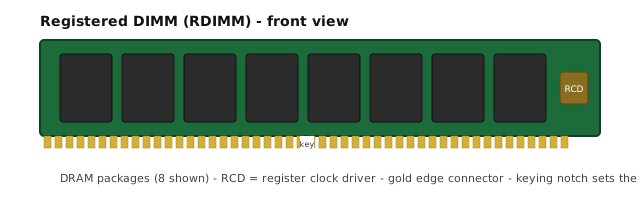
Short answer: a Dell or HP service part number is not a different module from the maker's part — it is the same physical memory under a vendor identifier, with vendor labelling and validation on top. What actually differs in the used market is not whose name is on the label, it is provenance and grade: where the module came from combined with whether it was functionally tested before it was packed.
Who actually makes server memory
Server vendors do not fabricate DRAM. Dell, HP and Lenovo buy modules and chips from the memory makers — principally Samsung, SK hynix and Micron — and then assign their own service part number, apply their own label, and run validation against their own platforms.
That means a "Dell" module and a "third-party" module of the same specification can be the same part from the same maker, differing in labelling, SPD programming and paperwork. It also means an unbranded module can be anything at all — which is the actual source of risk in the used market, and it is not the same thing as "OEM versus third-party".
What genuinely differs
| Dimension | OEM-labelled | Third-party / unbranded |
|---|---|---|
| Silicon | From Samsung / SK hynix / Micron | Usually the same makers; sometimes not identifiable |
| Part number | Vendor service number and maker number | Maker number, or no traceable number |
| Validation | Against specific vendor platforms, documented | None, or maker's own generic qualification |
| Firmware / SPD | Vendor-programmed, may carry platform hints | Standard JEDEC programming |
| Support | Counts as an OEM part under contract | Does not; may void support |
| Price, used | Higher, and can be much higher on scarce parts | Lower — this is the entire reason the market exists |
The price gap is real and it is not a scam. It is the market pricing the vendor's validation and paperwork, plus the scarcity of OEM-labelled stock on older generations.
The part number question, which trips up most buyers
The commonest error is concluding that because a part number looks different, the module must be different. It usually is not. Server memory is identified at several levels at once, and they all describe the same goods:
- The DRAM maker's part number — identifies the chip.
- The module maker's part number — identifies the assembly.
- The server vendor's service part number — identifies the same assembly as sold under that vendor's catalogue.
Our own lines carry the cross-reference for exactly this reason. The 16GB DDR4-2933 1Rx4 line cross-references DELL AB687113, HP P00920-B21, HP P06187-001 and HP P03051-091: four vendor numbers, one specification. The 32GB 2Rx4 line cross-references DELL SNP8WKDYC, DELL 8WKDY, HP P03052-09S and HP P12981-091. Any of those numbers is the same memory. Send whichever one is on your own records — we will match against it rather than requiring our own SKU. (These are interchangeable server-vendor part numbers, stated as a matching aid; they are not a claim of affiliation.)
When the OEM part is the only honest answer
We would rather say this up front than sell you the cheaper option.
- The machine is under a support contract. If the contract names OEM or approved parts, third-party memory can invalidate the support you are paying for. The saving on memory is trivial next to losing coverage on a production host.
- The firmware validates module part numbers. A number of OEM platforms check SPD data against an approved list and will not post on anything else. The module can be perfectly good and still not boot in that specific machine.
- It is a validated appliance. Where a vendor owns the bill for any fault, they also own the right to specify the parts. Do not put non-approved memory in it.
- The system is revenue-critical with no tolerance for a return. Buy the grade and the supply chain that removes the question, even where that costs more.
If any of those describes your machine, tell us and we will quote the OEM part or tell you where to get it. We will not sell you a pulled module for a host that should not have one.
When third-party and used makes sense
The cases where the value is real:
- General-purpose servers you control with a permissive memory QVL.
- Lab, test and build machines, where a failure costs an hour, not a contract.
- Fleets where you already run mixed components and validate your own stack.
- Older generations where OEM-labelled stock has become scarce and expensive — this is where third-party used memory is most obviously the right buy.
- GPU host systems, which are usually built from mixed parts by design.
What predicts reliability
Not the label. Two things do:
- Provenance. A module pulled from decommissioned working equipment has a history. A module of unknown origin does not. This is what the grade names are trying to communicate.
That is why grade is stated per line on our quotations rather than assumed, and why a test report ships with the goods instead of being available on request.
Mixing OEM and third-party modules
Within the same class, speed grade and rank, it generally works, and it generally trains to the slowest common set of timings across the channel. A few rules worth keeping:
- Never mix module classes. RDIMM, LRDIMM and 3DS variants do not populate together on mainstream DDR4 platforms — memory initialisation halts.
- Expect to lose any speed advantage if the modules are not all the same grade.
- For anything that has to be reproducible, buy one population in one lot. This is why we supply matched kits rather than loose quantities for platform-specific configurations.
How to buy without guessing
- Send the number you have. OEM service number, maker number, or just the specification. We match against what we can supply.
- Ask what grade the lot is. New, refurbished or pulled-and-tested — and get it restated on the quotation, not just mentioned in an email.
- Check the platform's rules before you commit. Support contract terms and any firmware part-number validation. Ask us, and we will tell you what we know.
- Ask for lot photographs and the test report before the lot ships. They should come as standard.
- Test in your intended population when the goods arrive, before the machine goes into service.
Common Questions
Is Dell-branded memory actually made by Dell?
No. Dell, HP and Lenovo do not fabricate DRAM or module assemblies for their server lines - that is done by the memory makers, principally Samsung, SK hynix and Micron. The vendor assigns its own service part number, prints its own label and adds firmware and validation on top. The silicon underneath is the same family either way.
Do OEM and third-party modules have identical specifications?
They are the same class of part - ECC registered DIMM at a stated speed grade, rank and organisation - but they are not guaranteed identical. Vendor validation covers a specific part number on a specific platform, and SPD programming can differ between an OEM-labelled module and an unbranded module of the same headline specification. Match on specification first, then on part number, then test.
Why does the same module carry several part numbers?
Because it is identified at more than one level. Our 16GB DDR4-2933 1Rx4 line cross-references DELL AB687113, HP P00920-B21, HP P06187-001 and HP P03051-091 - four vendor identifiers, one physical specification. That is why you should send us whichever number is on your own records; we match against it rather than requiring our own SKU.
When must I buy the OEM part?
When the machine is under a support contract that requires OEM or approved parts, when the platform's firmware validates module part numbers against an approved list and refuses to boot otherwise, and when the system is a validated appliance where the vendor owns the bill for any fault. In those cases buying used third-party memory is a false economy - we will tell you so rather than sell it.
Do third-party modules fail more often than OEM ones?
The data does not support a blanket answer, because 'third-party' covers both first-tier maker modules and unbranded assemblies of unknown provenance. What predicts reliability is provenance and grade - whether the module came from working equipment, and whether it was functionally tested before packing - not whose label is on it.
Can I mix OEM and third-party modules in one server?
Within the same class, speed grade and rank, it usually works and usually trains to the slowest common timings. It is not best practice for a production machine, because you lose the ability to say the population was validated as a set. If you need consistency, buy the whole population from one source in one lot.
Ask Ms Aya about a specific part number or platform, or check the part number cross-reference to see which stock line matches the number you hold.
 Ms Aya