
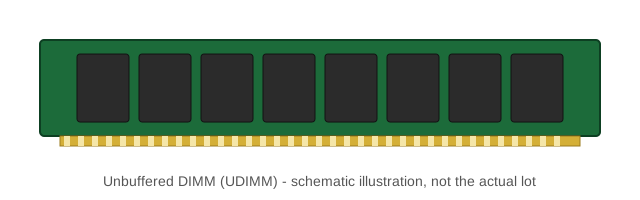
What is this part?
This is a 48.00 GB UDIMM module of the DDR5 generation rated at 5600 MT/s.
What condition is this lot in, and how is it tested?
One of 4 grades is used for every lot; this one is graded Used. Condition details for this lot are confirmed in writing with the quotation. Every quotation we issue states the grade, the test status and the physical condition of the lot, so that what you receive matches what you were quoted.
How many are available, and what is the lead time?
This line is supplied to your required quantity from Shenzhen. The lot is graded and tested in Shenzhen before shipment. Pricing is fixed as listed. For every order, request a quote with your target volume and delivery address and we confirm the quantity, the unit price and the shipping window in writing.
What is this lot compatible with?
Compatibility is decided by your platform, not by the part number alone: 4 attributes decide fit (form factor, capacity, rank and speed), plus ECC support where the platform requires it. UDIMM in the DDR5 class must be matched against your platform's own requirements before ordering — memory compatibility is determined by the server or workstation it is installed in, not by the part alone. The attributes that decide this are form factor, capacity, rank and speed. We do not claim compatibility with any specific system model, because the same part number can behave differently across BIOS revisions and configurations. Send us the platform make, model and firmware version with your enquiry and we will tell you plainly whether this lot is a match, and flag any attribute that needs confirming.
What should you check before you order?
3 attributes decide whether a lot like this is right for your build, and all three are readable from your platform documentation rather than from the module alone:
- Form factor and keying. The slot a module fits is determined by the platform, and the same capacity exists in mechanically incompatible variants. Confirm which one the chassis accepts before comparing prices.
- Rank and capacity per channel. Capacity is reached by combining ranks, and some platforms cap how many ranks a channel will address. A module that is electrically correct can still be unsupported if that limit is exceeded.
- Speed and ECC support. Installed speed is negotiated downward when the platform or the rest of the channel cannot run at the module's rating, so a faster module does not guarantee faster operation — it guarantees headroom.
Send us the platform make, model and firmware revision with your enquiry and we will read them against the lot and tell you plainly whether it fits, rather than leaving you to infer it from the listing.
How does grade affect price and risk?
2 modules with identical part numbers can differ several-fold in price, entirely because of history. New stock carries the lowest risk and the highest cost. Pulled-and-tested stock has been removed from decommissioned equipment and verified functionally, which is why it is the usual choice for buyers who need working parts at a fraction of new cost and who accept normal signs of prior use. Refurbished stock sits between these categories: cleaned, inspected and functionally verified before packing.
Grade is therefore a decision about who carries the risk, not about whether a part is good. A buyer with a test bench and a tolerance for a small failure rate can lower unit cost materially by choosing a lower grade; a buyer who cannot absorb failures should pay for the higher one. We state the grade on every quotation so that this choice is explicit rather than implied.
 Ms Aya